История одного шаблонизатора, от xml к xtpl и data-binding
			<div>
				{{if expr }}
					Вот поэтому Smarty и подобные плохи, {{$username}}.
			</span>
				{{/if}}
Очень велика степень ошибки, а сам шаблонизатор никак не проверяет валидность получаемого html.


Что у них общего?
			#!+ <!-- XML -->
			<xtpl:if test="expr"> .. </xtpl:if>
			#!- <xtpl:value> expr </xtpl:value>

			#!+ <!-- Smarty -->
			{{if expr }} .. {{/if}}
			#!- {{ expr }}
			new Parser({
				#! left: "<"
				#! right: ">"
				#!+ c_open: "<!--"
				c_close: "-->"
				tags: false
				trim: true
				#!- firstLine: true
			});
			new Parser({
				#! left: "{{"
				#! right: "}}"
				#! tags: "foreach include extends block ..."
			});
			<!-- XML -->
			<div>
				<xtpl:if test="expr">OK</xtpl:if>
			</div>

			<!-- Smarty -->
			<div>
				{{if expr}}OK{{/if}}
			</div>
			[{
				#! name: "div", type: 1, __open: true // <div>
			}, {
				#! name: "if", ns: "xtpl", type: 1, __open: true, // <xtpl:if
				#!+ attributes: [{
					#! name: "test", type: 2, value: "expr" // test="expr">
				#!- }]
			}, {
				#! name: "#text", type: 3, value: "OK" // текст в if
			}, {
				#! name: "if", ns: "xtpl", type: 1, __close: true // </xtpl:if>
			}, {
				#! name: "div", type: 1, __close: true // </div>
			}]
			[{
				#! name: "#text", type: 3, value: "<div>" // <div>
			}, {
				#! name: "if", type: 1, __open: true, // {{if
				#! attributes: "expr" // expr}}
			}, {
				#! name: "#text", type: 3, value: "OK" // текст в if
			}, {
				#! name: "if", type: 1, __close: true // {{/if}}
			}, {
				#! name: "#text", type: 3, value: "</div>" // </div>
			}]
			_trans: function (node, input, stack) {
				var val;
				switch (node.name) {
					#!+ case "if": // if test="expr"
						#! val = node.__open
							#! ? "__XIF=0;" + _try("__XIF=(" + node.attr("test") + ")", node) + "if(__XIF){";
							#! : "}"
					 	#!- break;
					#!+ case "foreach": // foreach data="array" item="val"
						val	= node.__open
								#! ? ("__XFOR=0;" + _try("__XFOR=" + node.attr("data"), node)
								#!+	+ "__buf.each(__XFOR, function (" + (node.attrAny("item", "__v")) + "){"
								#!- )
								#! : "});"
						#!- break;
				}
				// ..
			}
			var xtpl = require("AsyncTpl").engine("XML");
			xtpl.NS     = "xtpl";   // namespace
			xtpl.ASYNC  = true;     // async include templates
			xtpl.STREAM = false;    // streaming
			xtpl.ESCAPE = true;     // html escape all variables
			xtpl.DEBUG  = true;     // compile & run-time errors (console.log)
			xtpl.ROOT_DIR       = "./tpl/";
			xtpl.COMPILE_DIR    = "./tpl_c/";
			var smarty = require("AsyncTpl").engine("Smarty");
			smarty.LEFT = "{{";
			smarty.RIGHT = "}}";
			#!+ smarty.modifiers({ // {{ctx.expr|lower}}
				lower: function (val) {
					return val.toLowerCase();
				}
			#!- });
			<div>
				<xtpl:if test="ctx.expr">
					Hello!
				</xtpl:if>
			</div>
			function (ctx, __buf) {
				var __XIF;
				#! __buf.w("<div>");
				#!+ __XIF = 0;
				try { __XIF = ctx.expr; }  //  <xtpl:if test="ctx.expr">
				#!- catch (e) { xtpl.error(e, 1, "path/to.xml"); }
				#!+ if (__XIF) {
					__buf.w("Hello!");
				#!- }
				#! __buf.w("</div>");
				return __buf.toStr();
			}
Я начал пробовать шаблонизатор на реальных задача. Взял Backbone, написал простенький SPA и...
			<ul>
				#!+ <x:each data="ctx.users" as="user">
					#!+ <li>
						#! <x:value>user.get("name")</x:value>
					#!- </li>
				#!- </x:each>
			</ul>
			var UserList = new Backbone.View.extend({
				#! template: xtpl.compile("users.xml"),
				#!+ initialize: function () {
					this.listenTo(this.collection, "change", this.render);
				#!- },
				#!+ render: function () {
					#! var html = this.template({ users: this.collection.models });
					#! this.$el.html(html);
				#!- }
			});
			// Где-то в приложении
			users.fetch({
				success: function () {
					#!+ var list = new UserList({
						el: "#users",
						collection: users
					#!- });
					#! list.render();
				}
			});
			#!+ // это?
			#!- this.listenTo(this.collection, "change", this.render);
			#!+ <x:bind data="ctx.items" as="list">
				<ul>
					#!+ <x:each data="list" as="item">
						#!+ <li>
							<x:value>item.get("name")</x:value>
						#!- </li>
					#!- </x:each>
				</ul>
			#!- </x:bind>
<x:bind/> — создает замыкание (микро шаблон), подписывается на все события коллекции,
при изменении которой, заново рендерил связанный блок.
			#!+ __buf.w("<div id='uniqId'>"); // <x:bind
			#! try { __xbind = ctx.items; } catch (e) {} // data="ctx.items"
			#!+ __buf.bind(__xbind, "uniqId", function (list) { // as="list"
				__buf.w("<ul>"); // <ul>
				#!+ __buf.each(list, function (item) { // <x:each/>
					// вывод элементов
				#!- });
				__buf.w("</ul>"); // </ul>
			#!- });
			#!- __buf.w("</div>"); // </x:bind>
Это был очень долгий и сложный путь, как внедрить data binding в обычный js шаблон, чтобы он работал как на сервере так и браузере.
			<ul>
				<x:each bind="ctx.list" as="item">
					#!+ <li>
						<x:value bind>item.name</x:value>
					#!- </li>
				</x:each>
			</ul>
			#! <b>total: <x:value bind>ctx.list.length</x:value></b>
			<ul>
				<x:each bind/>  // [0]
					<li>
						<x:value bind/> // [0, $idx, 0]
					</li>
				</x:each>
			</ul>
			<b>total: <x:value bind/></b> // [1, 1]
			__buf.w("<ul>");
			#!+ __buf.bind("each", [0], // <x:each bind/>
					#!+ function () { // getter
						try { return ctx.list; } catch (e) {}
					#!- },
					#!+ function (__xbind0) { // микро шаблон
						__buf.w("<li>");
						#!+ __buf.bind("value", [0], function () { // <x:value bind/>
							#! try { return __xbind0.name; } catch (e) {} // getter
						}, function (__xbind0) { // микро шаблон
							#! __buf.v(__xbind0);
						#!- });
						__buf.w("</li>");
					#!- }
			#!- );
			__buf.w("</ul>");
			#! // и так далее
			input.btn.btn-success.xlarge[type="button"] {
			   on-tap: ctx.counter++;
			   value: ctx.counter || "Click me"
			}
			&btn = button.btn { // Обявляем элемент «btn»
			   #!+ class: "btn-{{ctx.mod || 'default'}}"
			   | {{ctx.text}} // это текстовая нода
			   if ctx.icon {
				  #! &icon { x-name: ctx.icon }
			   #!- }
			}
			#! &btn { x-text: "Fine", x-mod: "success", type: "reset" }
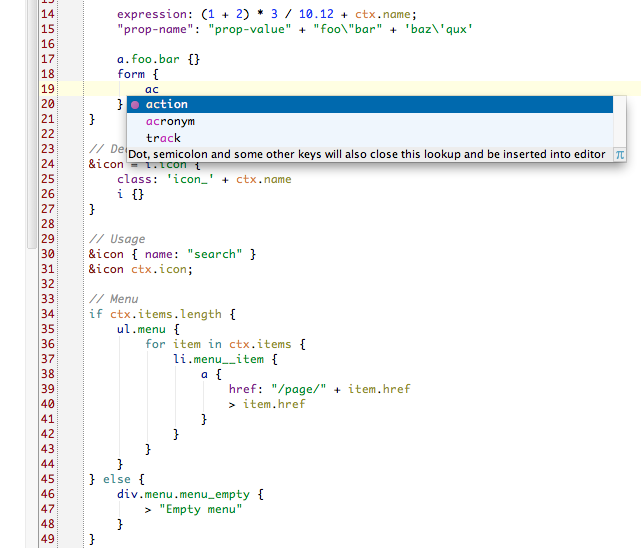
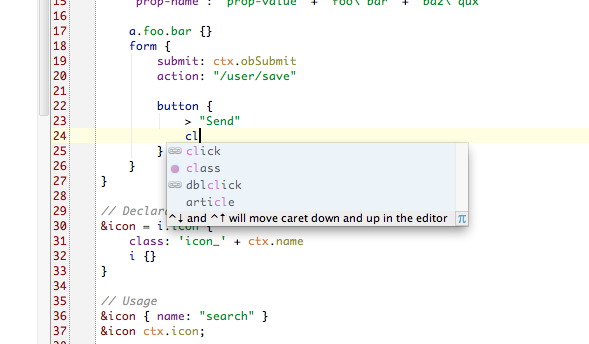
Если вы решили создать свой синтаксис, то позаботьтесь о поддержки им хоть в одной IDE, иначе оно не имеет смысла. Конечно это только мое мнение, но без этого будет крайне трудно использовать подобную поделку.


			xtpl.tag({
				"nodeName": {
					#!+ // Препроцессин
					#!- pre: function (node, attrs) { },
					#!+ // JavaScript код
					code: function (node, attrs) {
						#! return ["begin", "end"];
					#!- }
				}
			});
			xtpl.tag({ // loop[from=1][to=3] | {{$i}}
				#!+ "loop": function () {
					return [
						#! "for (var i = $from; i < $to; i++) {",
						#! "}"
					];
				#!- }
			});
			xtpl.decl("name", {
				#!+ compile: function (node, expr) {
					// Вызывается в момент компиляции
				#!- },
				#!+ init: function (el, value) {
					// Инициализация элемента (добавление в DOM)
				#!- },
				#!+ update: function (el, newValue, oldValue) {
					// Изменение значения
				#!- },
				#!+ remove: function (el) {
					// Удаления из DOM
				#!- }
			});
			xtpl.decl("x:show", {
				#!+ compile: function (node, expr) {
					var attrs = node.attrs;

					attrs.style = (attrs.style || "")
						+ ";{{" + expr + " ? '' : 'display: none;'}}";
				#!- }
			});
			// init(el, state) & update(el, state)
			xtpl.decl("x:autofocus", function (node, state) {
				#!+ if (state) {
					setTimeout(function () {
						#! el.focus();
						#!+ el.selectionStart =
						#!- el.selectionEnd = (el.value ? el.value.length : 0);
					}, 1);
				#!- }
			});
			xtpl.mod("name", function (value, ...rest) {
				// Модификатор значения
			});
			// Нужно: <b>Всего 2 письма</b>
			#! // Шаблон: b | Всего {{ctx.total | plural:"letters"}}
			#!+ xtpl.mod("plural", function (total, name) {
					#! // total — значение пеменной
					#! // name — название языковой константы
					#! return total + " " + i18n.plural(total, name);
			#!- });
// Нужно: <pre>{ "foo": "bar" }</pre>
// Шаблон: pre | {{ctx.data | pretty }}
#!+ xtpl.mod("pretty", function (value) {
return JSON.stringify(value, null, "\t");
#!- });
Как я говорил раньше, основное отличие в том, что теперь не нужно считать ноды, а шаблон всё также представляет из себя фунцию.
			#! input { x-model: **ctx.name**, placeholder: "Enter your name" }
			#! h2 | Hello **{{ctx.name}}**!
			var el = document.getElementById("target");
			xtpl.bind(el, templateStr, { name: "" });
			<div id="target">
				#!+ <!--attrs-->
					<input placeholder="Enter your name"/>
				#!- <!--/attrs-->
				#! <h2>Hello <!--x:value--><!--/x:value-->!</h2>
			</div>
			__buf.bindOpen("attrs"); // <!--attrs-->
			#! __buf.s("<input");
			#!+ __buf.bindEvent("input", // x-model="ctx.name"
				#!+ function (el, evt) { // слушатель
					try { ctx.name = el.value } // получение значения
					catch (e) { __xerr(e, "hello.xtpl", 2); }
				#!- }
			#!- );
			#!+ __buf.bindAttr("value", // x-model="ctx.name"
				#!+ function (__xargs) { // getter
					try { __xargs[0] = ctx.name }
					catch (e) { __xerr(e, "hello.xtpl", 2) }
				#!- },
				#!+ function (__xbind0) {  // setter
					__buf.w(__xbind0)
				#!-}
			#!- );
			#! __buf.s(" placeholder='Enter your name'/>")
			__buf.bindClose("attrs"); // <!--/attrs-->
			__buf.s("<h2>Hello ")
			#!+ __buf.b("x:value", // {{ctx.name}}
				#!+ function (__xargs) {  // getter
					try { __xargs[0] = ctx.name }
					catch (e) { __xerr(e, "hello.xtpl", 3) }
				#!- },
				#!+ function (__xbind0) { // setter
					try { __xval0 = __xbind0 }
					catch (e) { __xval0 = void 0; __xerr(e, "hello.xtpl", 3) }
					__buf.w(__xval0);
				#!- }
			#!- );
			__buf.s("!</h2>")
| total, ms | avg. per loop, ms | |
|---|---|---|
| Reactive | 69 984 | 23.33 |
| React | 52 950 | 17.65 |
| AngularJS | 49 815 | 16.61 |
| Vue | 43 141 | 14.38 |
| xtpl | 33 458 | 11.15 |
По-большому счету, это не готовый продукт, а исследование на тему, возможно ли доработать обычную js-функцию-шаблон до поддержки data binding, заставив всё это работать, как на сервере, так и клиенте. Как оказалось такой подход достаточно производительный и не уступает таким проектам как Angular или React, единственно что ему не хватает, это довести до ума :]